
Home
Music Sites
Student Portal
Free Scores
Commercial Sites
New Arts Press
Summa Musica
Score Software
Other Music Software
Diversions
Anthony Maydwell?

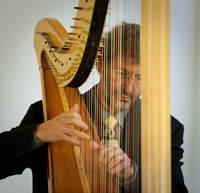
Through his position as lecturer, as harpist, and in his capacity as director of orchestral and choral music, Anthony Maydwell has an impressive if unusual reputation. As a child, Anthony Maydwell was a medallist in St Andrew’s Cathedral, Sydney. He began formal piano tuition at 5, taking up the harp at the age of 10.
Anthony began playing regularly with the Sydney Symphony Orchestra from the age of 16 with his first recordings and his concerto début for Musica Viva at 17. At 21 he was described as ‘a distinguished Australian musician’ (Sydney Morning Herald). While still studying Anthony Maydwell gained experience in conducting under Robert Pikler and Richard Gill, already experimenting with the rarer parts of the repertoire including Restoration masques and late Renaissance Italian madrigal.
In 1975, Anthony was awarded Student of the Year at the NSW State Conservatorium of Music. He was a member of AZ Music, The Seymour Group and regularly played with Opera Australia and Australian Ballet orchestras. After taking up the position as harpist with the West Australian Symphony Orchestra, Anthony Maydwell completed an MA at the University of Western Australia specialising in Trecento Madrigal, and later in 18th century performance practice.

Anthony has been on staff at the WA Conservatorium of Music since 1986. He has toured with the Hallé Orchestra and the Budapest Symphony; conducted first Australian performances of Haydn’s Seven Last Words in both orchestral and oratorio versions as well as conducting Australian premier performances of Sir Harrison Birtwhistle, Sylvano Bussotti, George Crumb, Debussy, Olivier Messiaen, and Gofredo Petrassi. For over a decade Anthony has directed the SUMMA MUSICA Chamber Choir which has won considerable acclaim performing both early and contemporary music, including the first Australian performances of works by Gallus, Gesualdo, Giovanetti, Hakim, Landi, Lassus, Lotti, and Macmillan, to name but a few.

Among highlights of his performing career starting with his first commercial recording aged 16 of Eugene Goosens' Trio for the ABC/World Record Club through to playing harp on the 2006 Naxos/Opus Arte DVD (OAF 4014D) of Britten's Turn of the Screw are but two of many memorable performances. From the beginning of 2000 to 2003 Anthony Maydwell was principal harpist in the Singapore Symphony Orchestra performing in both Singapore and China including harp on a new recording of the works of Richard Yardumian by the orchestra on the BIS label.

In 2003 Anthony Maydwell completed a new performing edition of Tomas Luis de Victoria's Lamentatio which was performed on Good Friday of that year. He also  directed performances of Janequin's Onomatopoeic Chansons, Debussy's Chansons de Bilitis, Monteverdi's Fourth Book of Madrigals (The previous year he directed a performance of Gesualdo's Fifth Book), and directed the WA Academy of Performing Arts 2003 season of Kurt Weill's Street Scene (A brief review appears in the March 2004 edition of Opera magazine).

Performances presented in 2004 included Saint-Saëns/Philip Cannon recital (Harp), Brahms' Requiem (Harp) and directed a performance of Berlioz works for choir and piano and selections from L'enfance du Christ with the Conservatorium Chorale. He also made a 'live' recording for broadcast by the ABC in October. He conducted performances of Handel's Zadok the Priest and Mozart's Coronation Mass in October. He performed on harp, works by Swiss composer F-J Zbinden with flute and Spanish-Cuban composer Morales Caso with viola in late October and early November and conducted SUMMA MUSICA in a performance of works by Pärt, Maxwell Davies and MacMillan in December.

In 2005 he directed a performance of Palestrina's fourth book of Lamentations for Good Friday and music of Rutter and Sir Michael Tippett. In June he directed the SUMMA MUSICA in a performance of Russian sacred music for the Perth Russian Festival and in early July conducted a choral concert of Vaughan Williams, Frank Martin and Murrill. He  presented Mozart's Mass in C minor in November and the first Australian performance of Rautavaara's Vigilia in early December.

For a  three-concert series starting on Good Friday 2006 he prepared an edition of Alexander Utendal's historically significant Penitential Psalms published in 1570 from part books held in the Royal Danish Library.  Four psalms performed on Good Friday and three psalms performed July 7.

After travelling to Bolivia and spending time in the Archivo Nacional Boliviana in Sucre during 2006 Maydwell commenced the reconstruction of works from the  Spanish colonial period. Good Friday 2007 saw the presentation by Summa Musica of two sets of lamentation settings of the works of Tomas Crecquillon and Johannis Gardani (first performance in modern times) found in a publication of settings by a number of composers from 1549. Both works have been re-edited by Anthony Maydwell from the 1956 thesis of Glen Watkins (the famous Gesualdo scholar) on Renaissance Polyphonic Lamentation settings.

Towards the end of 2007 Maydwell presented Stravinsky's L'Histoire du Soldat as well as other chamber music, opera and  orchestral harp playing in various concerts.
In November he conducted Summa Musica in the first Australian performance of Bo Holten's Songs of Heaven and Hell (1995).

In January Maydwell returned to the Archivo Nacional in Sucre, Bolivia and made a significant historical discovery of imprints from 1554 and 1598 in the bindings of 18th century Passion settings. These represent the earliest imprints in South America. He returned with hundreds of pages of manuscript in digitized form and has already begun the process of reconstruction. Some of the works completed will be performed by Summa Musica in June.

Anthony Maydwell directed a performance of Cristobal de Morales' Lamentation setting (published posthumously in 1564) on Good Friday.

Anthony Maydwell is also an editor of choral music, a computer engraver using the Score and Sibelius interfaces. In 2004 he completed a new edition of Pomponio Nenna's Responses for Holy Week (selections were performed in May by Collegium Vocale, Ghent). The responses for Maundy Thursday and Good Friday were presented on Good Friday, 2004 while the Wednesday Responses were performed in July 2004.  With ex-Conservatorium lecturer Alan Bonds he has established the Perth Score Archive, an internationally recognised repository of publicly available scores, and is an occasional speaker for arts and community organisations such as Alliance Française, the Goethe Institute, Musica Viva, Rotary International and the Western Australian Symphony Orchestra.